
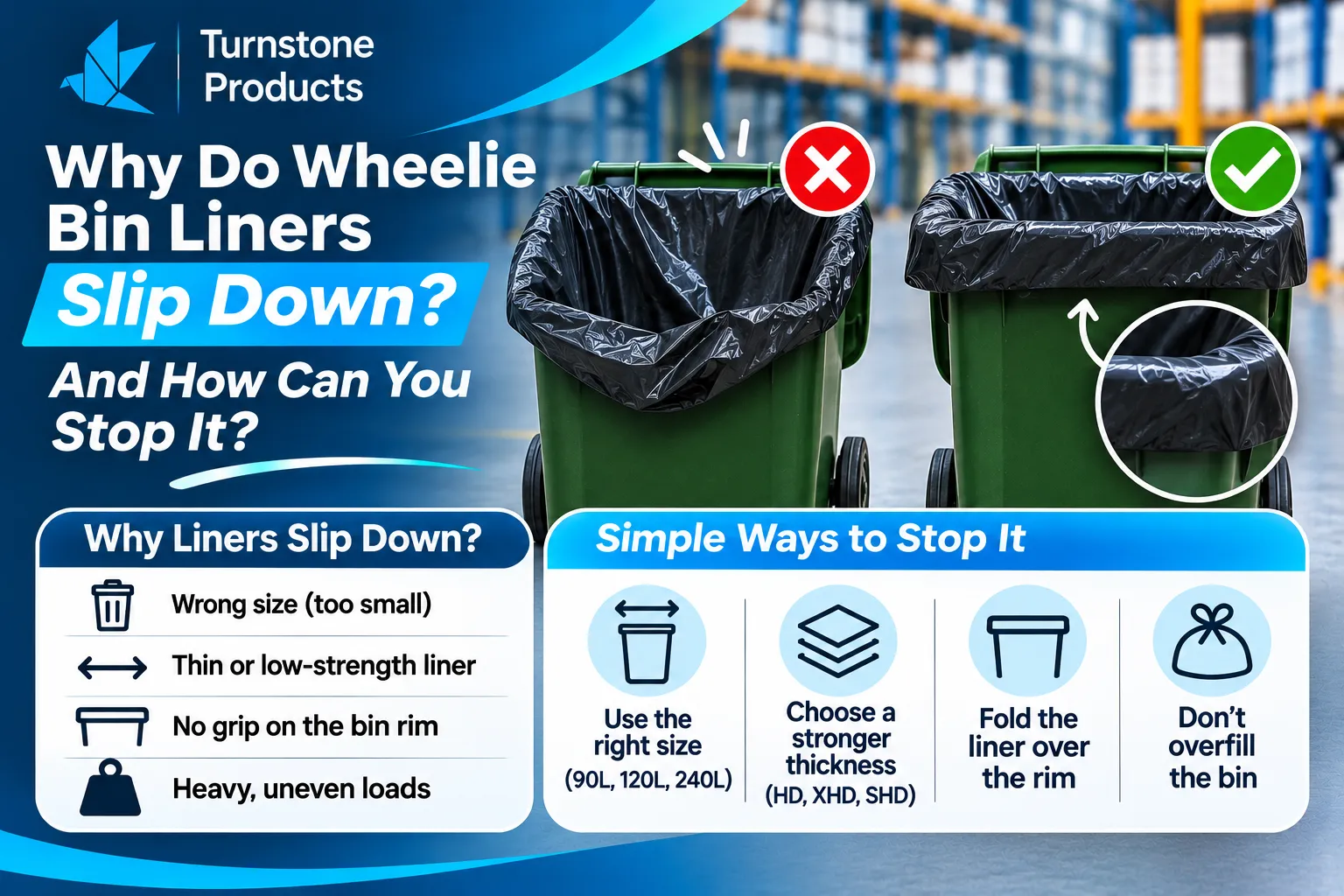
Quick answer: Wheelie bin liners slip when they are too narrow or too short to fold securely over the rim, when trapped air stops them reaching the bottom, or when heavy waste drags them down. Measure your bin and choose a liner with enough length and width for a generous overhang, push the air out before folding, and change bags before they get too heavy.
Anyone who empties commercial bins knows the scene. You lift the lid and the liner has slid to the bottom, leaving rubbish pressed against the plastic walls. Now the bin needs scrubbing and the bag is half buried.
For cleaning contractors, restaurants, warehouses and property managers, it happens far too often. The usual reaction is to buy thicker bags, but slipping is mostly a fit problem, not a strength problem.
Strength still matters for heavy loads. For bins that take wet or dense waste, suitable heavy duty bin liners keep the bag intact once it is full. But first, the reasons bags slip.
Why Wheelie Bin Liners Slip
The liner is too small
This is the most common cause. Many businesses buy by litre capacity alone, but two 240L bins from different manufacturers can have different openings and depths. If the liner only just reaches around the rim, there is nothing left to grip. As soon as waste goes in, the bag pulls away.
Air is trapped underneath
When a liner is dropped into a bin, air often gets trapped beneath it, so the bag sits halfway down instead of at the bottom. The first heavy load pushes it the rest of the way, dragging the folded edge off the rim as it goes.
The overhang is uneven
If one side has a long fold and the other barely covers the rim, the short side gives way first. Once one edge slips, the rest soon follows.
Heavy waste pulls the bag down
Food scraps, wet waste and dense packaging all add weight quickly. If the fit is already marginal, that weight is enough to drag the liner off the rim.
The rim is smooth or worn
Some bins have rounded, glossy rims that offer little grip. Old bins with worn or damaged edges can be even worse.
How to Measure for the Right Size
Choosing bin liners for wheelie bins is much easier with a tape measure than with a litre figure. Take three measurements:
-
The opening. Measure the length and width of the top of the bin.
-
The height. Measure from the inside floor of the bin to the rim.
-
The base. Note whether the bin narrows towards the bottom.
Then check the liner’s flat dimensions against them:
-
Length: a useful rule of thumb is the bin’s height, plus half the base width, plus 10 to 15 cm to fold over the rim. A liner shorter than that will struggle to reach the bottom and still grip the edge.
-
Width: the open bag should go around the rim comfortably, without being pulled tight. If you have to stretch it to get it over the edge, it is too narrow.
These are general guides. Compare your measurements with the supplier’s listed liner dimensions, and fit a sample in your actual bin before ordering in volume.
A liner that passes both checks will reach the bottom without stretching and still leave a solid fold around the rim.
How to Fit a Liner So It Stays Put
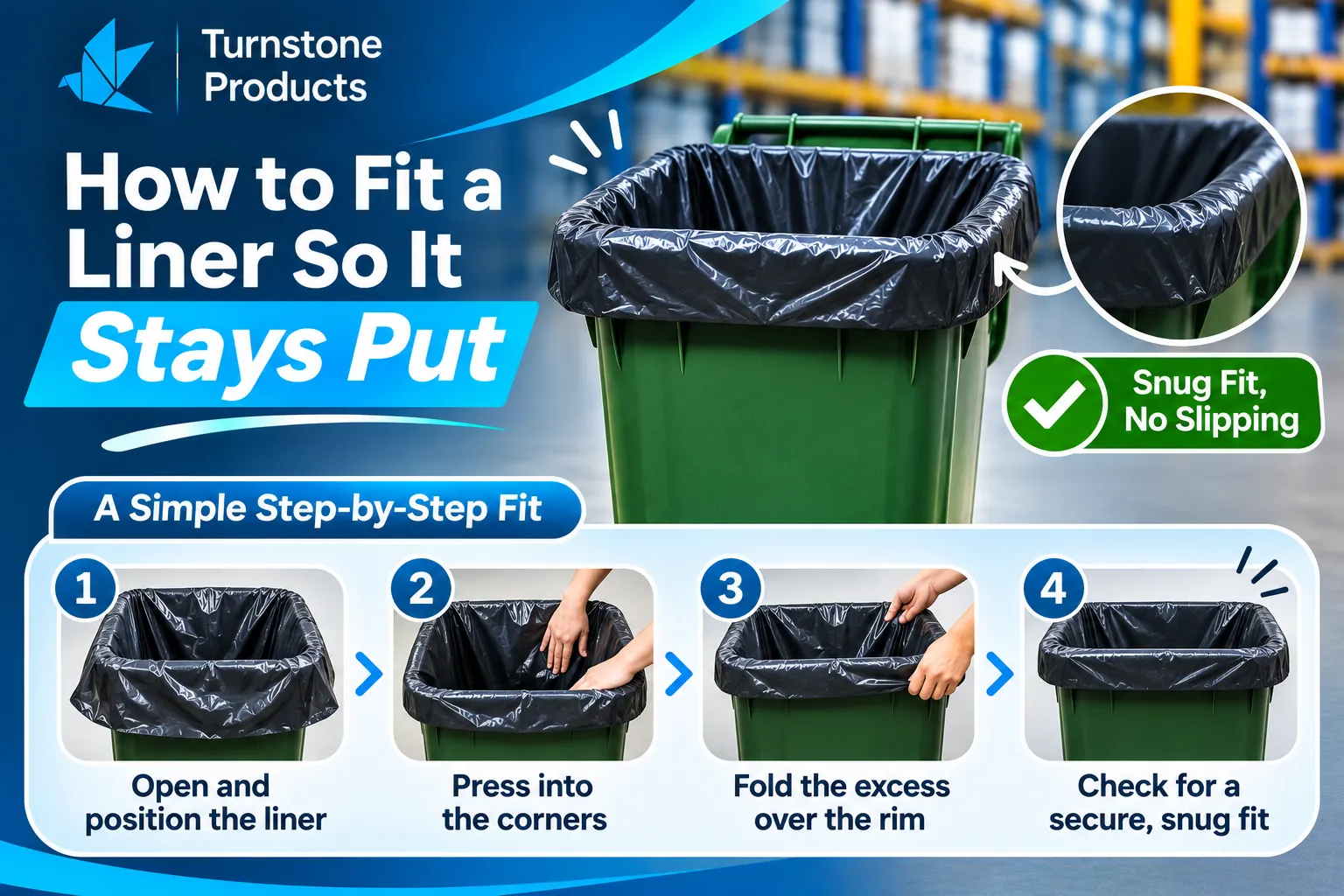
Even a well-sized liner can slip if it goes in carelessly. This routine takes a few seconds:
-
Open the bag fully before it goes in, shaking it out so the bottom is square.
-
Lower it to the bottom and press it gently into the corners.
-
Push the air out. Run your hand down the sides so trapped air escapes before you fold the top.
-
Fold evenly so every side has a similar overhang, ideally 10 cm or more.
-
Tuck the fold under the rim where the bin design allows, or use a retaining band.
Using retainers and bands
Bin liner retaining bands and clips are designed to hold the fold in place on compatible bins. They are especially useful at loading docks and in outdoor bins that are opened often. Choose one that suits your bin and does not interfere with the lid closing or create a handling hazard.
Check before you fill
Train staff to glance at each new liner once fitted. If it does not reach the bottom or the fold looks thin, fix it before rubbish goes in.
Does a Heavy Duty Liner Stop Slipping?
Not on its own. A thick liner that is too narrow will still pull away from the rim. Thickness affects strength and puncture resistance, not grip.
Bin liner thickness is measured in microns. A 25 micron heavy duty liner suits many commercial bins, while a 30 micron extra heavy duty liner suits wet, heavy or bulky loads. The right grade depends on what goes into the bin and how the bag is handled. Fit comes first; grade comes second.
Where heavy grades do help is preventing tears once the bag is full. That matters most at removal time, when a full 240L liner is lifted out. Wheel the bin to collection where possible, and follow your workplace’s manual handling procedures for heavy loads.
Buying in Bulk Without Getting the Size Wrong
Sites with many wheelie bins usually buy liners by the carton. Ordering several cartons of the wrong size is an expensive mistake, so check compatibility first. Heavy duty bin liners bulk orders make the most sense once you have confirmed the fit.
A quick checklist helps:
-
List every bin on site with its capacity and measurements.
-
Note which bins take light waste and which take heavy or wet waste.
-
Compare liner widths, lengths and grades against your bins.
-
Ask for samples and fit them in your actual bins.
-
Trial them for a week under normal conditions.
-
Compare cost per liner and bags per carton.
-
Estimate monthly use so you do not overorder.
Sticking to a few liner sizes also simplifies ordering.
The Real Cost of Slipping Liners
A slipped liner creates extra work every time. Rubbish collects in the bin, which then needs cleaning, and half-buried bags are more likely to tear on removal. Across many bins, that adds up to wasted liners and hours of staff time.
Why Choose Turnstone Products?
Turnstone Products is a Western Australian, family-owned supplier of commercial cleaning products and workplace consumables, based in Neerabup. It supplies businesses in hospitality, healthcare, childcare, commercial cleaning and industry across Perth.
-
Liners for every bin. From small kitchen tidy bags through to 120L and 240L wheelie bin liners.
-
Grades to suit the waste. Heavy duty and extra heavy duty options for bins that take wet, dense or bulky rubbish.
-
Clear product dimensions. Compare liner sizes against your bins before you buy, and ask the team for help choosing.
-
Bulk pricing by quote. Bulk buyers contact the team for carton and multi-carton pricing.
-
Next-business-day delivery. Eligible Perth metro orders, from Yanchep to Mandurah, are delivered the next business day, with Australia-wide supply for bulk orders.
Frequently Asked Questions
Why does my bin liner fall into the bin?
It is usually too small to fold securely over the rim, has air trapped underneath, or is being dragged down by heavy waste. Check the size and push the air out before folding.
Can I use a 240L liner in a 120L wheelie bin?
It will fit, but the excess plastic makes it awkward to handle and wastes material. A liner sized for a 120L bin is the better choice.
Will a thicker bin liner stop slipping?
No. Thickness improves strength, but correct sizing and fitting are what keep a liner in place.
Conclusion
Wheelie bin liners slip because of poor fit, trapped air, uneven folding or heavy waste, rarely because the bag is too thin. Measure your bins, choose liners with enough length and width, fit them carefully and change them before they get too heavy. Then pick the grade that suits the waste.